Thoughts on xAI Grok 4.7 in Cursor
Elijah Chew, ACS (International)
I have been building in Cursor long enough to notice when a model change actually matters. Grok 4.7, xAI’s coding model, is the first one in a while that made me change which chat I open on purpose, not just because it was the default.

Older models were fine at completing a thought I had already started. They would fill in a component, rename a file, or follow a pattern I had already put on the page. They got lost when the job was to decide the shape of the thing: what the page is for, which state actually exists, whether this should even be a feature. I spent a lot of time steering them back.
What 4.7 does differently
Grok 4.7 is better at holding the whole problem. If I say the site has to stay honest about dates, or that a student has to stay in charge of the math, it does not immediately forget that three messages later. It also argues less by dumping code. It will still write a lot, but I can usually tell why a file changed.
It is not magic. If my prompt is vague, I still get a vague site. The difference is that when I am specific, 4.7 stays with the constraint instead of inventing a prettier version of a product I did not ask for.
The numbers behind that
xAI published Grok 4.7 as a coding and knowledge-work model, at $2 per million input tokens and $6 per million output, the same price as Grok 4.6. I care about the Cursor numbers, because that is where I actually use it.
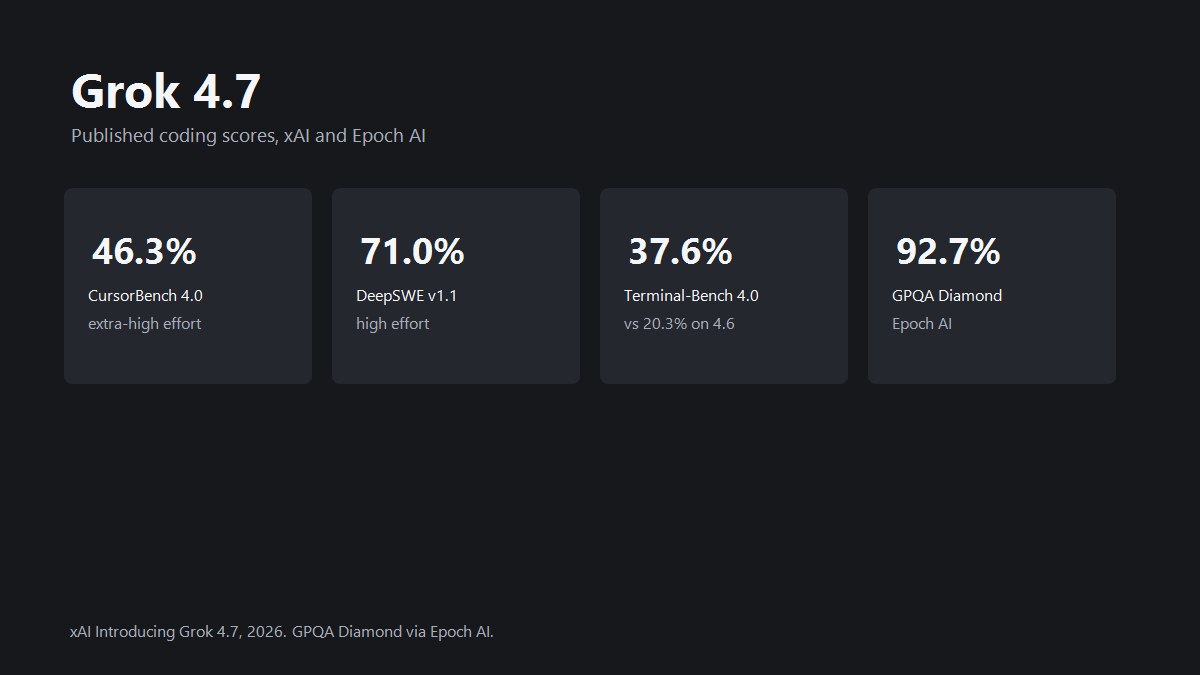
On CursorBench 4.0, which is long-running coding work from real Cursor sessions, Grok 4.7 scored 46.3% at extra-high effort. Grok 4.6 was 40.4% on the same bench. GPT-5.6 Sol Max was 41.7%. Fable 5.1 Max was ahead at 51.8%. On DeepSWE v1.1, 113 original software-engineering tasks across 91 repos, 4.7 hit 71.0% at high effort, up from 65.2% on 4.6. Terminal-Bench 4.0 went from 20.3% on 4.6 to 37.6% on 4.7.
Those are not my scores. They are xAI’s, and CursorBench is the one that maps to how I work: a long task, a messy repo, a constraint that has to survive more than one file. Epoch AI also has 4.7 at 92.7% on GPQA Diamond. That is graduate-level science questions, not a website. I mention it because it matches the feeling I get when the job is to hold a whole argument, not just fill in a component.
Composer for simple, Grok for higher
I like Cursor’s Composer for the small jobs. Rename this. Align that. Add a dropdown. Move a heading. Those tasks should be cheap and fast. Composer is enough, and I do not need a long conversation to change padding.
I use Grok when the work is higher: rewriting a post so the timeline is true, deciding how a page should read, or building something where the next step is not obvious. That is where an older model would sprint in the wrong direction and I would spend the evening undoing it.
The split is the same as the rest of how I like to build. Simple work should stay simple. Hard work should get the model that can actually sit with it.
xAI on Grok 4.7 (opens in a new tab)Grok 4.7 in Cursor (opens in a new tab)What I've learned building websitesWhat I have been learning